Ashenhave’s Ghost-Touch Crisis
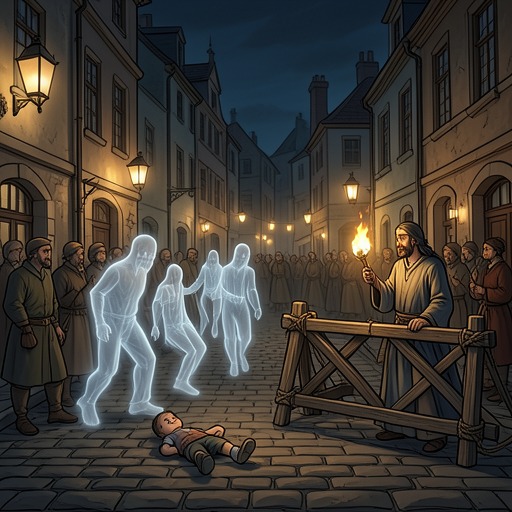
The Reincarnated Demon King's Host Just Wants to Live in Peace, But the Hero Won't Leave Him AloneAshenhave’s Ghost-Touch Crisis is a town-wide haunting in which ghosts inflict a debilitating condition on the living, while an old, nested spirit at an abandoned well stirs up other ghosts. The crisis makes Ashenhave’s fear tangible: barriers and a nightfall lockdown mark the town as dangerous before the afflicted residents and the hidden source of the haunting come into view. Theo and Wicker’s complementary healing and ghost expertise offer a response, but the source remains unresolved at the end of the documented episode.
Setting and Warning Signs
The party reaches Ashenhave at dusk after a storm-induced rockslide has forced a detour east and south, over a small mountain range. Nearly two weeks have passed on the road, and autumn is shortening the days. As the town comes into view, the party finds temporary fencing around its main section and dark windows even at farms along the approach. The signs suggest a community trying to contain a threat rather than simply prepare for night.
Malthios senses strange presences just as Wicker detects ghosts nearby. Veiv confirms that this is the season for them and suggests the barriers may have been erected in response. Avery observes that the town should have magical wards as well as physical ones, given the presence of an Adventurer’s Guild and the apparent availability of magic-users. That question points to a gap in the town’s defenses: the party sees signs of danger, but not a protective system capable of keeping it out.
Lockdown and Negotiation
At the boundary, Luc identifies the travelers as the Hero’s party and asks to enter to rest and resupply. A voice from the town refuses: no one may enter or leave after nightfall, and the sentry demands proof that the visitors are who they claim to be. Wicker responds by identifying the ghost problem and offering specialized help; Veiv offers to ward every home. The proposals prompt discussion inside the town, but do not immediately open its gates.
Instead, the voice challenges the party to survive the night outside and promises only that the town will discuss the matter in the morning. Avery bristles at being denied entry, while Wicker recognizes fear behind the hostility and explains that ghosts can be terrifying, particularly when wronged. The exchange establishes the lockdown as both a safety measure and an obstacle to aid: Ashenhave’s people are wary of outsiders, even as the haunting leaves them in need of expertise.
The Afflicted Residents
Once inside, Theo finds that the inn’s main room has been cleared of its tables and chairs to make space for at least a dozen bedrolls. The arrangement has turned a public room into an improvised ward. Theo detects ghost-touch in the air, an oppressive presence he associates with old blood, rust, and fresh grave dirt. More lanterns add warm light, but it does not soften the visible condition of the victims: their exposed skin has turned grey and blue, and their lips, eyelids, and nostrils look almost frostbitten.
A man with an eyepatch identifies the most seriously afflicted resident as the town witch, a young woman around Theo’s age and apparently half-elf. She was touched while saving a child on the first night the ghosts attacked. Theo scans her with his magic and orders that the barren fireplace be lit. Keeping the victims warm, he explains, can stave off the touch; the witch is nearly gone. Her condition places a human cost beside the town’s barriers and warnings: the haunting has already reached someone who put herself between a child and danger.
Theo continues healing through the night. By morning, he is exhausted, and Garris expresses the town’s gratitude while asking whether the ghosts can be stopped. Wicker says that the investigation can proceed, having studied several ghosts during the night and needing to check details about recent events. Veiv, with Avery, plans to establish ghost wards on the houses, farms, and shops. Her wards are stronger than Avery’s, but even his will improve on having no protection. Treatment, investigation, and prevention thus become separate parts of the response rather than a single remedy.
The Nest and the Proposed Resolution
The crisis has a source beyond the ghosts encountered around town. Wicker explains that one old ghost, linked to an abandoned well in the forest, has stirred the others. Those drawn into the haunting probably include a mixture of people the old ghost killed and spirits of Ashenhave’s former residents. The danger is therefore not only a collection of individual apparitions: the well-bound ghost is the focus around which other dead have gathered.
Theo’s own recovery is slowed because contact with the source bombarded him with the ghost’s emotions and memories. Wicker had been reluctant to confront the nest sooner, fearing for Theo after that contact. The explanation makes his exhaustion more than the aftermath of a long night of healing; his exposure to the central ghost has left him carrying an additional burden. When Bryony asks whether the spirit can be freed, Wicker says that the nest must first be destroyed, after which Wicker and Theo can put the soul to rest. Wicker expects the other ghosts to disperse once that is done.
Significance and Unresolved Outcome
The episode distinguishes immediate relief from a lasting solution. Theo’s healing addresses those already touched, warmth helps stave off the condition, and wards may protect the town’s buildings and farms; none of these measures, on its own, removes the old ghost’s influence. Wicker’s proposed sequence—destroy the nest, then lay the soul to rest—directly addresses the source and offers a reason the surrounding ghosts might depart. The account ends with that work still ahead: Luc asks whether Theo can fight, and Theo says that rest should restore him. Ashenhave has found a way to receive help, but the threatened confrontation has not yet been completed.